OVERVIEW

One Platform. Connected Enterprise Operations.

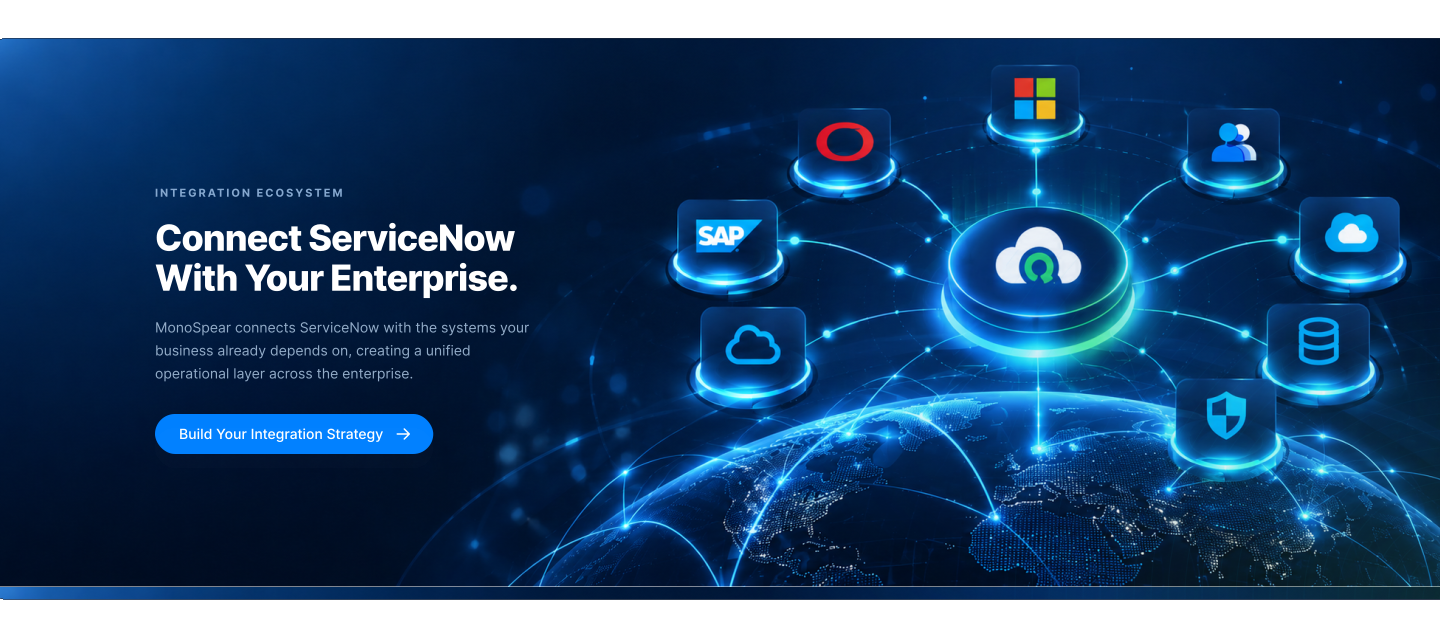
ServiceNow brings IT, employees, customers, security, and business operations onto a single digital workflow platform. MonoSpear helps organizations turn that platform into measurable operational outcomes — engineering the CMDB, workflow logic, and integration layer so ServiceNow becomes the enterprise system of action, not just another system of record.
ServiceNow Capability 1
ServiceNow Capability 2
ServiceNow Capability 3
KEY CAPABILITIES

Explore ServiceNow Capabilities

From service operations to enterprise workflows, MonoSpear helps you unlock the capabilities that matter most.

ServiceNow Capability 4
ServiceNow Capability 5
ServiceNow Capability 6
ServiceNow Capability 7
IT Service Management
IT Operations Management
Customer Service Management
Security Operation

IT Service Management

Modernize IT service delivery with structured, auditable workflows for incidents, requests, problems, and changes

Unified Service Catalog

A single, demand-driven catalog replacing scattered request forms and shadow spreadsheets.

CSDM-Aligned CMDB

Configuration items mapped to business services so impact analysis is accurate, not guessed

Change Risk Scoring

Automated risk assessment on every change request using your own historical change data.

Major Incident Workflow

Structured war-room, communication, and post-incident review process baked into the platform.

IT Service Management Team
MORE SERVICENOW CAPABILITIES

More ServiceNow Capabilities

More ServiceNow Capabilities
ServiceNow Ecosystem
INDUSTRIES WE SERVE

Built for complex, asset-intensive operations.

Industry 1Industry 2Industry 3Industry 4Industry 5
ServiceNow Data
FREQUENTLY ASKED

What Experts Ask Before They Sign Off

Don't see yours here? A solutions architect from your region can walk through scoping, staffing or pricing directly.

Ask us directly →

We start from your CSDM and service model, not the product's default data model. Every module we deploy — ITSM, ITOM, CSM, SecOps, HR — is mapped back to a single, governed configuration item structure, so reporting stays accurate as you add modules instead of fragmenting over time.

Yes. We architect domain separation for holding companies, franchises, and post-merger organizations that need shared platform infrastructure with strict data isolation between business units, without duplicating instances.

We tune Predictive Intelligence and Virtual Agent models against your historical ticket and case data before go-live, and instrument automation with measurable deflection and resolution-time targets rather than deploying generic bots.

Yes. We regularly assess and remediate existing instances — cleaning up CMDB health, workflow sprawl, and technical debt — before extending scope, so you are not building new automation on an unstable foundation.

Foundational ITSM typically takes 8-12 weeks; layering ITOM Discovery and Service Mapping on top adds 6-10 weeks depending on infrastructure complexity and the maturity of your existing CMDB data.